

-
Research Article
-
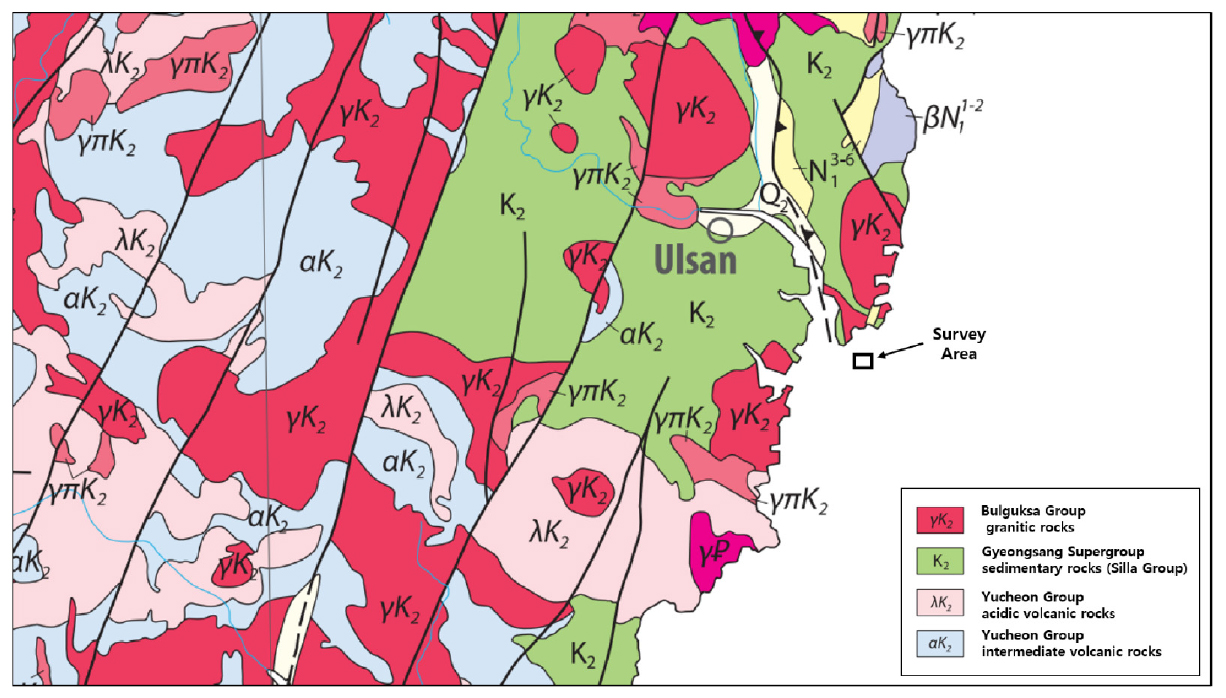
Spatial Correlation Analysis between Acoustic Basement Depth and Marine Magnetic Anomalies Derived from Sub-Bottom Profiling and Marine Magnetic Survey Data in the Offshore Area of Ulsan Port
울산항 해역에서의 천부지층탐사 음향상 기반암과 해양 자력탐사 자기이상 사이의 공간적 상관관계 분석
-
Eun Min Yeo, Chan Su Kim, Seung Pyo Choi, Sung-Ryul Shin, Wookeen Chung
여은민, 김찬수, 최승표, 신성렬, 정우근
- This study quantitatively analyzed the spatial correlation between acoustic basement depth and magnetic anomalies by integrating Chirp sub-bottom profiler (SBP) data and …
본 연구에서는 울산항 해역에서 취득한 천부지층탐사(Chirp SBP)와 해양 자력탐사 자료를 통합하여, 음향상 기반암 심도와 자기이상의 공간적 상관관계를 정량적으로 분석하였다. 음향상 기반암 심도와 …
- This study quantitatively analyzed the spatial correlation between acoustic basement depth and magnetic anomalies by integrating Chirp sub-bottom profiler (SBP) data and marine magnetic survey data acquired off Ulsan Port. Acoustic basement depth and magnetic anomalies were normalized to a 0–10 range, and their variation patterns were compared along representative survey lines. For the combined dataset of three representative lines, the Pearson correlation coefficient was r = –0.802 and the Spearman rank correlation coefficient was ρ = –0.845, indicating a strong negative correlation. This result implies an inverse spatial relationship in which magnetic anomalies are larger where the acoustic basement is shallower. However, in sections with thick sedimentary cover and weak reflector continuity, uncertainty in acoustic basement interpretation may increase, suggesting the need for additional validation. Despite these limitations, the joint application of sub-bottom profiling and marine magnetic surveys provides an effective approach for improving the reliability of shallow stratigraphy and basement structure interpretation in port and coastal areas.
- COLLAPSE
본 연구에서는 울산항 해역에서 취득한 천부지층탐사(Chirp SBP)와 해양 자력탐사 자료를 통합하여, 음향상 기반암 심도와 자기이상의 공간적 상관관계를 정량적으로 분석하였다. 음향상 기반암 심도와 자기이상을 0–10 범위로 정규화한 후, 대표 측선에서 두 변수의 변화 양상을 비교하였다. 세 대표 측선 통합 자료에서 Pearson 상관계수 r = −0.802, Spearman 순위상관계수 ρ = −0.845로 나타나 강한 음의 상관관계가 확인되었다. 이는 기반암이 얕을수록 자기이상이 크게 나타나는 반비례적 공간 관계를 의미한다. 다만 퇴적층이 두껍고 반사면 연속성이 약한 구간에서는 음향상 기반암 해석의 불확실성이 증가할 수 있으므로 추가 검증이 필요하다. 이러한 한계를 고려하더라도, 천부지층탐사와 해양 자력탐사의 병행은 항만 및 연안 지역에서 천부 지층과 기반암 구조 해석의 신뢰성을 높이는 데 유효한 접근법임을 보여준다.
-
Spatial Correlation Analysis between Acoustic Basement Depth and Marine Magnetic Anomalies Derived from Sub-Bottom Profiling and Marine Magnetic Survey Data in the Offshore Area of Ulsan Port
-
Research Article
-
Application of Electrical Resistivity Surveys for Monitoring Carbon Dioxide Leak Detection in Groundwater
지하수 내 이산화탄소 누출 탐지를 위한 전기비저항탐사 모니터링 적용
-
Man-ho Han, In-Ky Cho, Keun-Soo Lee, Yuhan Kim, Jiho Shin, Myeong-jong Yi
한만호, 조인기, 이근수, 김유한, 신지호, 이명종
- Leakage of carbon dioxide (CO2) from carbon capture and storage (CCS) site into shallow aquifers can substantially affect the groundwater …
이산화탄소 포집 및 저장(Carbon capture and storage; CCS) 기술에서 저장된 이산화탄소(carbon dioxide; CO2)가 천부 대수층으로 누출될 경우 지하수 환경에 심각한 …
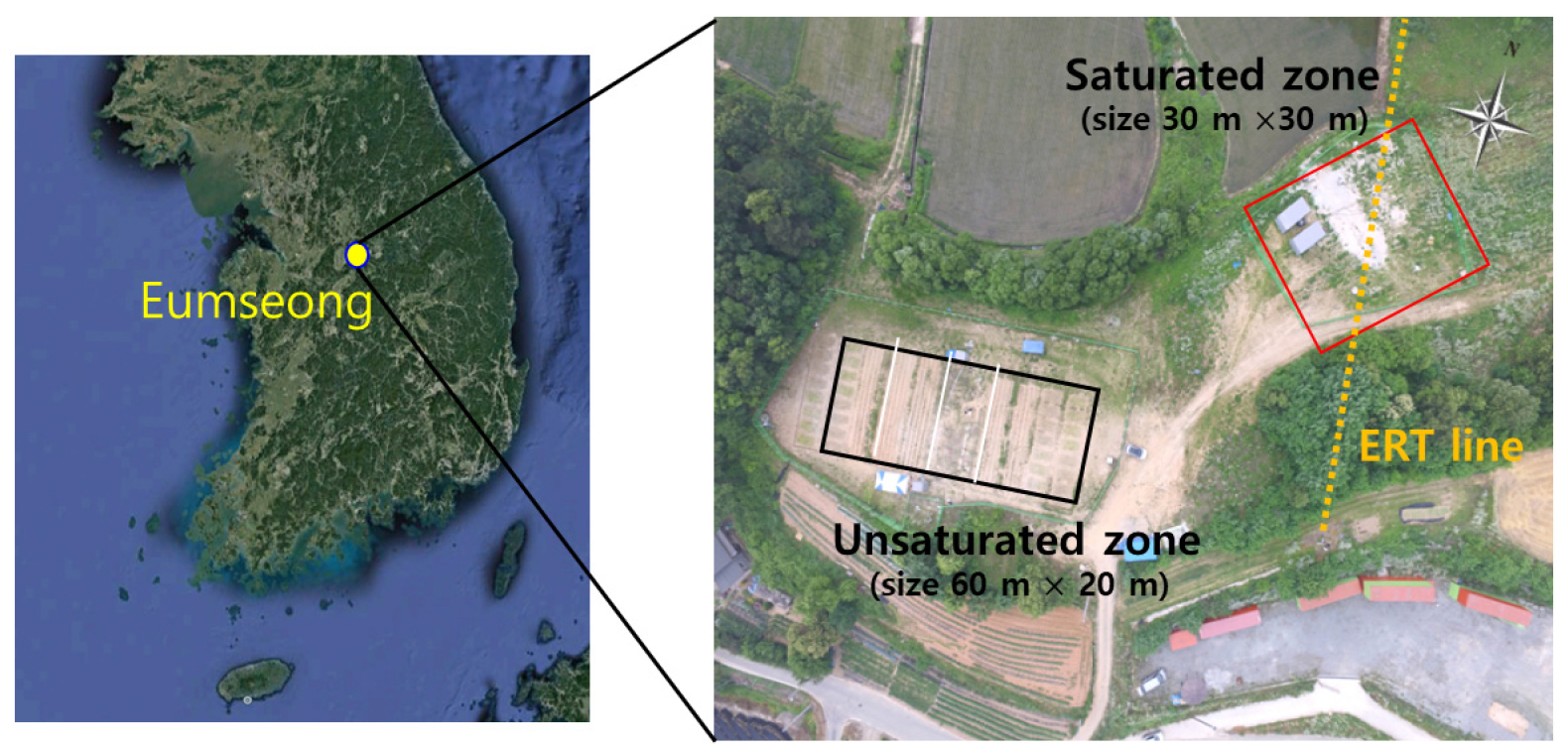
- Leakage of carbon dioxide (CO2) from carbon capture and storage (CCS) site into shallow aquifers can substantially affect the groundwater environment. This study evaluated the applicability of electrical resistivity monitoring for detecting CO2 leakage into groundwater. Using a controlled-release test facility constructed in the saturated zone in Eumseong, Chungcheongbuk-do, Korea, CO2-dissolved water was continuously injected at a rate of 5.5 m3/d days through an injection well and screened at a depth of 21~24 m. A 100-m-long surface resistivity profile with a 5-m electrode spacing was deployed, monitoring data were acquired using a pole-dipole array, and four-dimensional (4D) inversion was performed on data from nine selected measurement phases (T1~T9). Difference images relative to the baseline phase (T1) revealed an increase in resistivity beneath the pumping well (location A) caused by water-level drawdown following the onset of pumping, whereas a decrease in resistivity attributed to the inflow of CO2-dissolved water was observed near the injection well (location B) beginning at approximately 81 h after the start of injection (T4). During phases T6~T9, the zone of reduced resistivity at location B progressively expanded, with the resistivity ratio decreasing to a minimum of 0.74. Although field conditions, including intensive rainfall during the monsoon season and electrode disconnections, limited continuous data acquisition, the results confirmed that 4D electrical resistivity monitoring can effectively detect the subsurface distribution and migration of CO2.
- COLLAPSE
이산화탄소 포집 및 저장(Carbon capture and storage; CCS) 기술에서 저장된 이산화탄소(carbon dioxide; CO2)가 천부 대수층으로 누출될 경우 지하수 환경에 심각한 영향을 미칠 수 있다. 본 연구는 지하수 내 CO2 누출을 탐지하기 위한 전기비저항 모니터링의 적용 가능성을 평가하였다. 충북 음성군에 구축한 포화대 인공조절 누출 시험시설을 활용하여, 심도 21~24 m 스크린 구간에 설치된 주입정을 통해 CO2 포화수를 5.5 m3/d의 유량으로 28일간 연속 주입하였다. 전극 간격 5 m, 총 연장 100 m의 지표 전기비저항 측선을 구성하고 단극-쌍극자 배열로 모니터링 자료를 취득하였으며, 선별된 9개 시기(T1~T9)의 자료에 대하여 4차원(4D) 역산을 수행하였다. 기준 시기(T1) 대비 차이영상 분석 결과, 양수 개시에 따른 지하수위 하강 효과로 양수정 하부(A지점)에서 전기비저항 증가가 확인되었으며, 주입 개시 약 81시간 이후(T4)부터 주입정 인근(B지점)에서 CO2 포화수 유입에 기인한 전기비저항 감소가 관찰되었다. T6~T9 기간 동안 B지점의 비저항 감소 영역이 점진적으로 확대되어 비저항 비가 최소 0.74까지 감소하였다. 장마 기간의 집중 강우와 전극 단선 등 현장 여건으로 인해 연속 자료 취득에 제약이 있었으나, 4D 전기비저항 모니터링이 지층 내 CO2의 분포 및 거동을 효과적으로 탐지할 수 있음을 확인하였다.
-
Application of Electrical Resistivity Surveys for Monitoring Carbon Dioxide Leak Detection in Groundwater
-
Research Article
-
Lineament Analysis for Selecting HLW Disposal Sites: A Review of the Finnish Case and Preliminary Application to Korean Data
고준위방사성폐기물 심층처분시설 후보부지 선정을 위한 선형구조 분석 연구: 핀란드 사례 분석 및 한국 데이터 예비 적용
-
Yu-Han Kim, Jeong-Hwan Lee, Mi-Jin Kwon, Se-Vin Oh, Man-Ho Han
김유한, 이정환, 권미진, 오세빈, 한만호
- The site selection of a deep geological disposal facility for high-level radioactive waste is a step-by-step process that must include safety related …
고준위방사성폐기물 심층처분시설의 부지 확보는 장기간의 안전성을 입증하기 위해 다양한 평가가 요구되는 단계적인 과정이며, 부지선정 초기 광역 조사 단계에서 고려되어야 할 다양한 지질 …
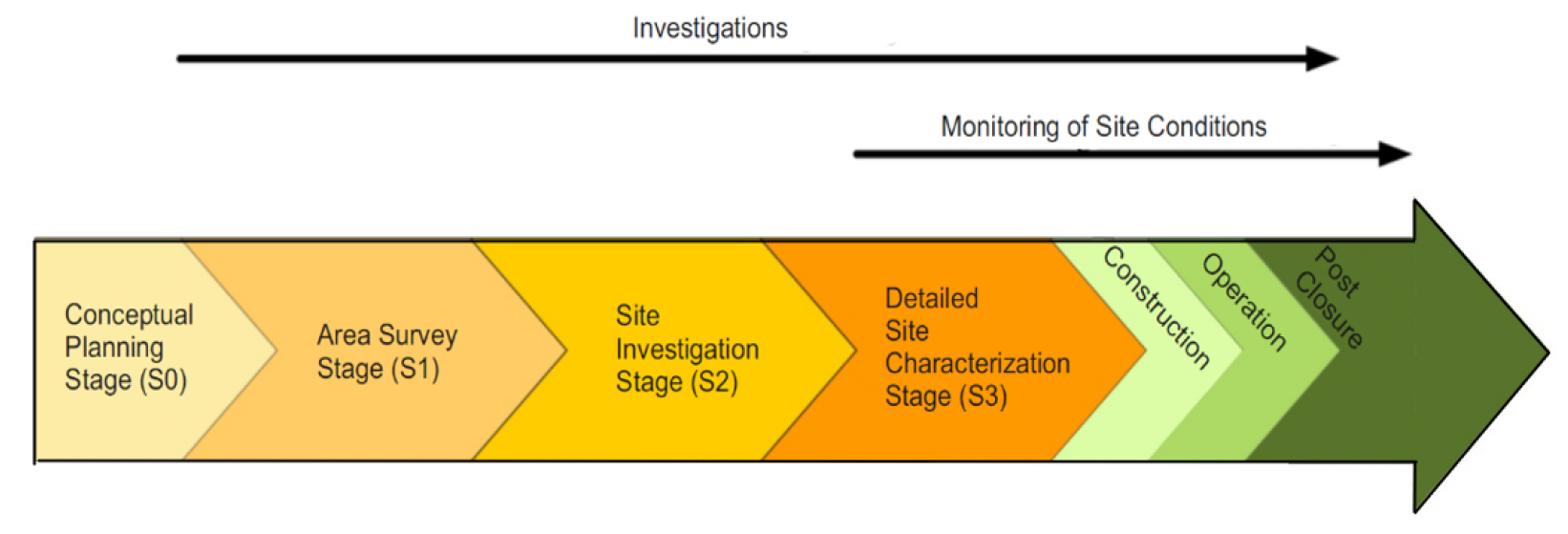
- The site selection of a deep geological disposal facility for high-level radioactive waste is a step-by-step process that must include safety related considerations from various perspectives. Among the various geological factors or indicators, the identification of lineaments is important as they serve as key data indicating the stability, fractures, and faulting of the bedrock. In this study, the Finnish case based on lineament analysis was reviewed and applied to the Korean peninsula satellite imagery, airborne gravity and magnetic survey data, to analyze lineaments. After this analysis, the newly proposed concept of “Respect Distance” was applied and examined. To clearly define the criteria for judging whether a lineament is a disqualifying feature, a preliminary procedure is introduced that makes interpretation more precise. However, to verify the interpretations and ensure accuracy, continuous data collection, detailed analysis and eventually on-site investigations at the site selection stage are necessary.
- COLLAPSE
고준위방사성폐기물 심층처분시설의 부지 확보는 장기간의 안전성을 입증하기 위해 다양한 평가가 요구되는 단계적인 과정이며, 부지선정 초기 광역 조사 단계에서 고려되어야 할 다양한 지질 인자들 중, 선형구조 분석 결과는 기반암의 구조적 안전성과 단층 및 파쇄를 파악하는 데 중요한 자료로 활용된다. 본 연구에서는 선형구조에 의해 구획되는 안정적 암반 블록을 도출하는 핀란드 적용 사례를 고찰하고, 이를 국내 수치표고모델(DEM), 항공 자력 및 중력탐사 자료를 예비적으로 적용하여 전국 규모의 선형구조를 도출하였다. 도출된 선형구조에 대하여 선형구조의 연장에 비례하는 영향거리(Respect Distance)를 적용하여 살펴보았다. 본 연구는 광역 규모 단위에서 구조적 배제 요건 판단을 위한 일관된 예비 분석 절차를 확립했다는 데 의의가 있으나, 광역 지구물리 및 지형 자료가 내포하는 해상도의 한계를 극복하고 도출된 선형구조의 실제 제원을 검증하기 위해서는, 향후 부지선정 및 상세 특성화 단계에서 고해상도 현장 조사와 다중 스케일 자료 분석이 병행되어야 한다.
-
Lineament Analysis for Selecting HLW Disposal Sites: A Review of the Finnish Case and Preliminary Application to Korean Data
-
Research Article
-
Evaluation of a Leakage Index using Resistivity Monitoring Data in Earth-fill Dams
전기비저항 모니터링에 의한 필댐 누수지수 산출
-
Keun-Soo Lee, Hwan-Ho Yong, Ki-Seog Kim, In-Ky Cho
이근수, 용환호, 김기석, 조인기
- More than 85% of fill dams in Korea exceed 50 years of age. These structures face severe risks of accelerated leakage and …
국내 필댐·저수지의 85% 이상은 50년 이상 경과된 노후 댐으로, 내부침식 및 세굴 현상에 의한 누수현상이 가속화되고 있으며, 잠재적 붕괴 위험에 직면하고 있다. …
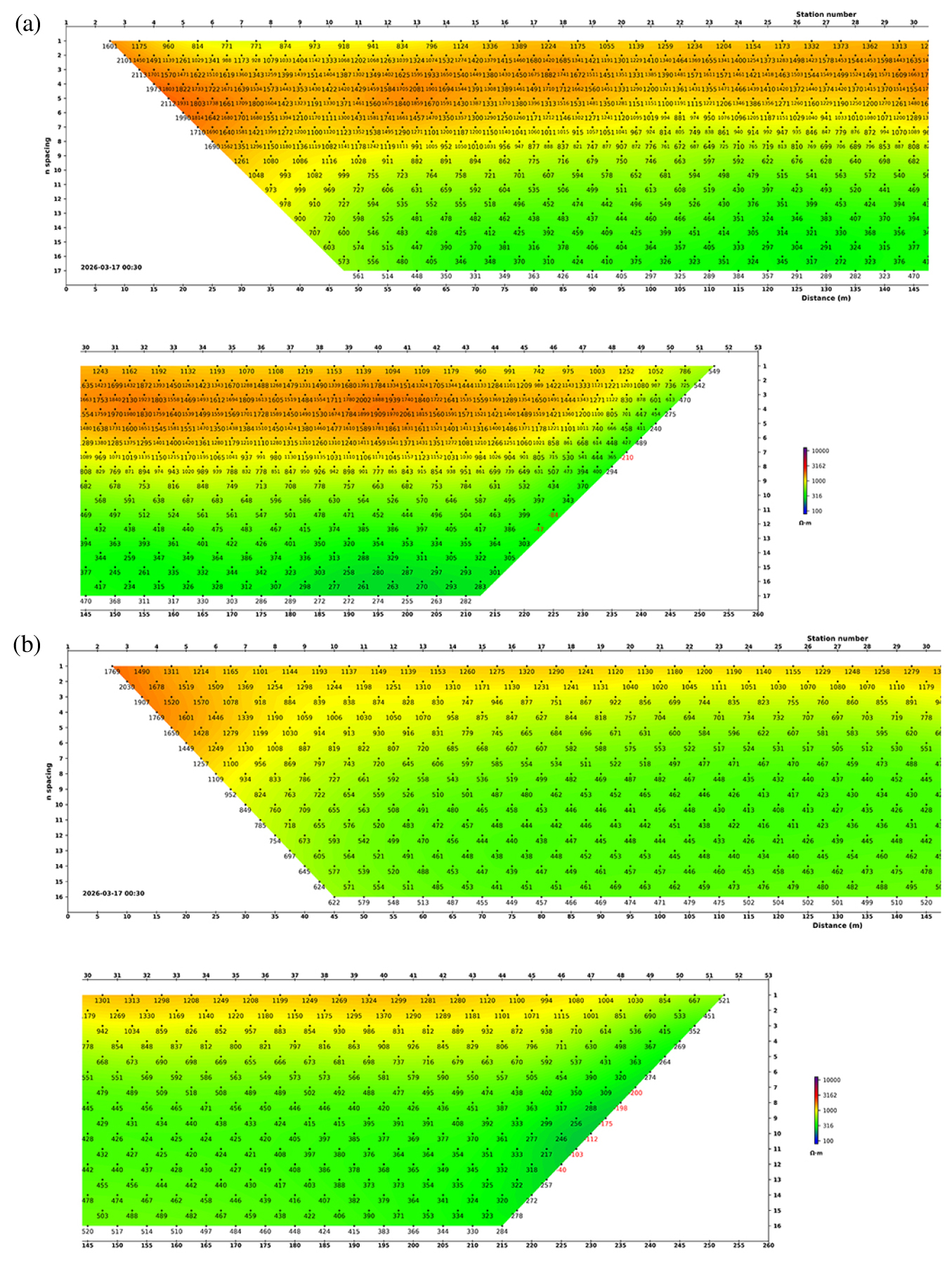
- More than 85% of fill dams in Korea exceed 50 years of age. These structures face severe risks of accelerated leakage and collapse due to internal erosion and piping. Electrical resistivity surveys are commonly used for safety inspections because they provide non-destructive, real-time, and in-situ assessments. However, current interpretations simply classify low-resistivity zones as leakage points. Even monitoring methods remain at a rudimentary stage of interpretation, merely comparing resistivity change ratios over time. To address this, we analyzed resistivity time-series to extract water content, which directly correlates with leakage volume. Based on this water content, we developed a new leakage index evaluation method. Finally, we examined the validity of this method using field data.
- COLLAPSE
국내 필댐·저수지의 85% 이상은 50년 이상 경과된 노후 댐으로, 내부침식 및 세굴 현상에 의한 누수현상이 가속화되고 있으며, 잠재적 붕괴 위험에 직면하고 있다. 전기비저항 탐사는 댐의 전반적인 상태 파악은 물론 누수대의 발달 여부 탐지가 가능한 비파괴, 실시간, 현장 조사법으로 필댐·저수지 안전진단에 널리 사용되고 있다. 그러나 전기비저항 탐사에서는 단순히 저비저항대를 누수대로 해석하며, 모니터링의 경우에도 전기비저항 변화율을 영상화하여 단순 비교하는 해석 단계를 벗어나지 못하고 있다. 이 연구에서는 전기비저항 모니터링 자료에서 얻어진 전기비저항 시계열을 분석하여 누수량과 직결된 수분함량을 추출하고, 이에 근거한 정량적 누수지수 산출법을 개발하였다. 또한 개발된 누수지수 산출법을 현장자료에 적용하여 그 타당성을 검토하였다.
-
Evaluation of a Leakage Index using Resistivity Monitoring Data in Earth-fill Dams
-
Research Article

-
Crossover Error Analysis and Correction of UAV-borne Three-Component Fluxgate Magnetic Survey Data
드론 탑재 삼성분 플럭스게이트 자력탐사자료의 교차점 오차 분석 및 보정
-
Gyeongseo Jeong, Mijeong Kim, Hanjin Choe
정경서, 김미정, 최한진
- Recent advances in unmanned systems technology continue to bring substantial changes to the field of exploration. In particular, geophysical surveys using unmanned …
최근 무인 시스템 기술의 발전에 따라 탐사 분야에 큰 변화가 발생하고 있으며, 특히 무인 멀티콥터를 활용한 탐사는 저비용으로 접근이 어렵거나 험준한 환경에서도 …
- Recent advances in unmanned systems technology continue to bring substantial changes to the field of exploration. In particular, geophysical surveys using unmanned aerial vehicles (UAVs) are widely employed due to their efficient low-cost operation, even in inaccessible or rugged environments. UAV-based magnetic surveys generally use scalar and vector magnetometers among which, the fluxgate magnetometer, a vector magnetometer, offers the advantage of being easily mounted on small mobile platforms although it exhibits relatively high noise levels and pronounced line-to-line errors. To analyze and remove its error source, we performed crossover error correction. Because UAV surveys involve short flight times of 1-2 hours and the platform is composed of paramagnetic materials, the influence of viscous magnetization is minimal, and linear errors are not prominent. Accordingly, we confirmed that the crossover errors were effectively corrected through line-to-line leveling correction alone. Furthermore, the crossover errors of the vector-component anomalies were larger than those of the scalar anomaly and arose from inherent errors in the attitude sensor; we quantitatively demonstrated that these differed fundamentally from the scalar errors, because the scalar magnetic intensity is a rotational invariant. By quantitatively evaluating and verifying the effectiveness of crossover correction in drone-based fluxgate magnetic surveys, this study contributes to improving the reliability and accuracy of future vector survey data.
- COLLAPSE
최근 무인 시스템 기술의 발전에 따라 탐사 분야에 큰 변화가 발생하고 있으며, 특히 무인 멀티콥터를 활용한 탐사는 저비용으로 접근이 어렵거나 험준한 환경에서도 고효율의 탐사가 가능하여 널리 활용되고 있다. 드론 기반의 자력 탐사에는 일반적으로 스칼라 및 벡터 자력계가 이용된다. 그 중 벡터 자력계인 플럭스게이트 자력계는 소형 이동체 탑재가 용이하다는 장점이 있다. 반면, 잡음이 상대적으로 크고 측선 간의 오차가 뚜렷하게 나타난다. 우리는 이러한 오차의 원인을 분석하고 효과적으로 제거하기 위해 교차점에서 오차 보정을 수행하였다. 드론 탐사는 비행 시간이 1-2시간 이내로 짧고, 플랫폼 특성상 상자성체로 구성되어 있어 점성자화의 영향이 미미하여 선형 오차가 크게 두드러지지 않는 것으로 여겨진다. 따라서 측선 간 레벨링 보정만으로 교차점 오차가 효과적으로 보정됨을 확인하였다. 또한 벡터 성분이상의 교차점 오차는 스칼라 이상의 교차점 오차보다 크게 나타났으며, 이는 자세 센서의 내재된 오차로 인해 발생한 것으로 회전 불변량의 스칼라 오차와는 본질적으로 기원이 다름을 정량적으로 규명하였다. 본 연구는 드론 기반 플럭스게이트 자력 탐사에서 교차점 보정의 효과를 정량적으로 평가 및 검증함으로써, 향후 벡터 자료의 신뢰도와 정확도를 향상시키는 데 기여할 것으로 기대된다.
-
Crossover Error Analysis and Correction of UAV-borne Three-Component Fluxgate Magnetic Survey Data

Journal Informaiton
 Geophysics and Geophysical Exploration
Geophysics and Geophysical Exploration






 Korean Society of Earth and Exploration Geophysicists
한국지구물리물리탐사학회
대전 유성구 대학로 31, 한진오피스텔 1804호
Tel: 042-826-1804 / Fax: 042-826-1809 / E-mail: kseg@seg.or.kr Copyright© Korean Society of Earth and Exploration Geophysicists. Powered by APUB
Tel: 042-826-1804 / Fax: 042-826-1809 / E-mail: kseg@seg.or.kr Copyright© Korean Society of Earth and Exploration Geophysicists. Powered by APUB